We believe in dark data. And we’re creating more of it.
That probably sounds backwards, so let us explain.
What is dark data, anyway?
In the data world, “dark data” refers to information that gets collected but never analyzed, such as logs sitting on a server somewhere, sensor readings that feed nothing, and archives nobody has touched in years. It’s there, but no one can access the insights.
Consider astronomy: researchers have been discovering new celestial objects by analyzing telescope images through modern tools. The data existed, but the tools to interrogate it hadn’t caught up yet. When they did, our understanding of the sky evolved.
Radio is heading in a similar direction. Decades of RF experimentation, propagation logging, and signal data are sitting in archives. Newer machine learning tools — not the chatbot kind, the pattern-recognition-in-large-datasets kind — are getting good enough to find structure in that noise.
The question is whether there’s enough data to work with, and whether it covers the right parts of the spectrum. For most of the spectrum, the answer is yes. For the long waves, not so much.
A century-old detour
Radio started on the long waves. The earliest wireless telegraphy operated at wavelengths measured in kilometers, and for a brief period, that’s where all the action was.
Then, technology caught up, and everyone moved on to HF, VHF, UHF, and microwave. Each step up the frequency ladder brought more practical antennas, more bandwidth, and better noise floors. Long waves became a curiosity, and eventually, frequencies most engineers actively avoid.
That shift made sense. If you’re trying to stream data or run a cellular network, there is nothing useful about a wavelength you can’t fit in a city block.
But “not useful for communications” doesn’t mean “scientifically insignificant.”
What long waves can do that nothing else can
Low frequencies have unique properties. Substances that stop a microwave dead, such as oil, rock, and water, are partially transparent to a long wave. That makes subterranean imaging a real possibility yet to be explored.
The atmospheric behavior is different, too. Long-wave propagation is sensitive to conditions in the ionosphere and lower atmosphere in ways that HF and above simply aren’t. Long-wave data offer valuable insights to researchers studying pre-seismic electromagnetic anomalies, atmospheric conductivity shifts, space weather signatures, and more.
The problem is that the data barely exists. The petabytes of RF data humanity generates every day come from medium-wave and up (e.g., AM radio, cellular, WiFi, and 5G). Long-wave coverage is thin by comparison, mostly because working in that part of the spectrum is genuinely challenging.
Why long waves are hard
Operating below 500 kHz is an exercise in fighting physics on multiple fronts simultaneously.
Radiation resistance in the long waves is measured in milliohms. Your antenna is working against an impedance that makes a short circuit look like a good deal. Atmospheric noise is severe. Everything connected to a power outlet contributes to interference. Meanwhile, current simulation software doesn’t handle propagation modeling in complex terrain well.
Then, there’s the space problem. A quarter-wave antenna at 472 kHz is about 158 meters tall. Nobody’s building that in their backyard. Even a practical compromise like a loaded vertical or an inverted L demands a large property, a serious ground-radial system, and ideally some elevation. An acre of ground radials barely gets you started.
Next, we must consider location. Long-wave signals are extraordinarily sensitive to interference from the power grid, switching regulators, and nearby electronics. Suburban or semi-rural sites with neighbors, grid noise, and cellular infrastructure are non-starters. You need genuine RF silence, which means distance from populated areas and natural terrain shielding.
That combination of acreage, RF isolation, and terrain that doesn’t actively destroy propagation is rare. Most people who want to experiment in this part of the spectrum don’t have access to it.
We do. Our 20-acre site in Kern County sits at 3,500 feet in a natural bowl surrounded by mountains. There’s no cell service. Broadcast intrusion is minimal. The terrain provides shielding that can’t be replicated with filters. The noise floor is low enough that subtle, slow-moving effects that take weeks of continuous monitoring to become visible actually show up in the data.
What we’re doing with the data
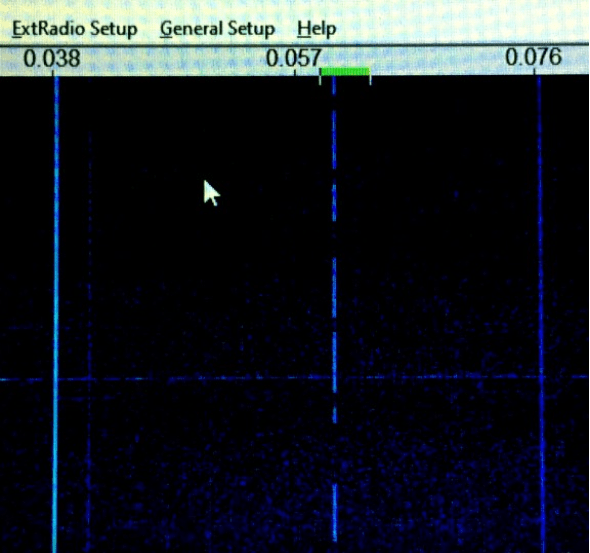
Our site features a mix of open terrain and canyon geometry that creates unusual propagation conditions. We run a multi-antenna setup across several bands, including 630m (472 kHz), with ongoing experiments on ground-wave behavior, atmospheric correlation, and signal propagation in challenging environments.
Before starting ClearSkyRF, I spent decades in battery analytics, machine learning, and high-performance RF design from UHF to Ku-band before landing on this particular obsession. The through-line is the same in all of it: large datasets plus novel analysis tools reveal things that weren’t visible before.
We think the long waves have secrets. We’re here to find out.
 ClearSkyRF
Leave a comment