For me, Amateur Radio is about designing and building equipment, experimenting, and learning. I have done so for/on almost every amateur frequency, from 630m to X-band. Rag chews or contesting do not speak to me much. My antennas are mostly omnidirectional, simple, and resonant, including a full-wavelength loop on 472 kHz. However, reality forces me to settle for a 630m loop that is just a fraction of a wavelength above ground.
I’ve been working on this back-to-basics WSPR beacon since June, 2025.
If you pick up my WSPR beacon on 80m, this is what the signal came from: a homebrew built-from-first-principles design. The oscillator is a 74HC00 NAND gate. The NTSC color burst crystal was modified with a Sharpie to oscillate on 3570.1 kHz.
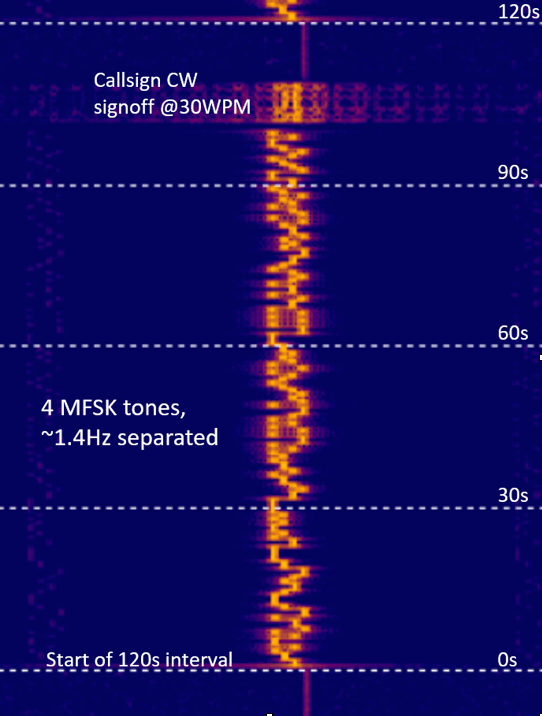
A second NAND gate is used to gate the oscillator signal, producing CW. I sign off my WSPR transmissions with my callsign in CW.
The microcontroller is an ATTiny88 in some Arduino form factor. I never developed an interest in object-oriented programming, so I usually wipe the bootloader and write my own code in assembler or sometimes a higher-level language.
Time comes from a DS3121 RTC. Drift is deep sub-second per day, but it needs occasional tuning to keep the drift under a second.
WSPR modulation is created by driving a low-pass-filtered PWM signal into a reverse-biased red LED, which is used as a varactor in the crystal circuit. A few pF is enough to pull the crystal over the ~4.5Hz range dictated by the WSPR protocol.
The PA is a 74AC240 with two times 4 drivers driven differentially. I measured the differential output impedance to be about 17 ohms, so I use a 5:1 balanced-to-balanced impedance transformer (a balbal?), giving about 90 ohms to the antenna port. LPF is a 5th-order differential Butterworth LC filter. I know I should not have used an SMA connector, but I was originally not planning on a differential drive.
Power is a single Li-Ion cell, with no power conversion. This causes about 20Hz of drift over the supply range. The 2Ah cell powers the beacon through the night.
The transmission line to the antenna is about 30m / 100ft of Cat-5 network cable.
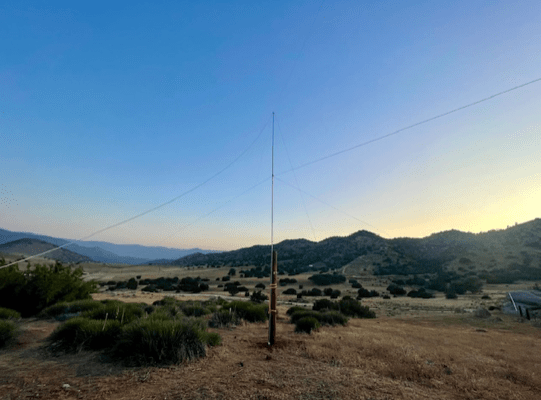
The antenna is an inverted V with the apex at 30ft / 10m, but unfortunately, 100mW will not boil off any clouds.
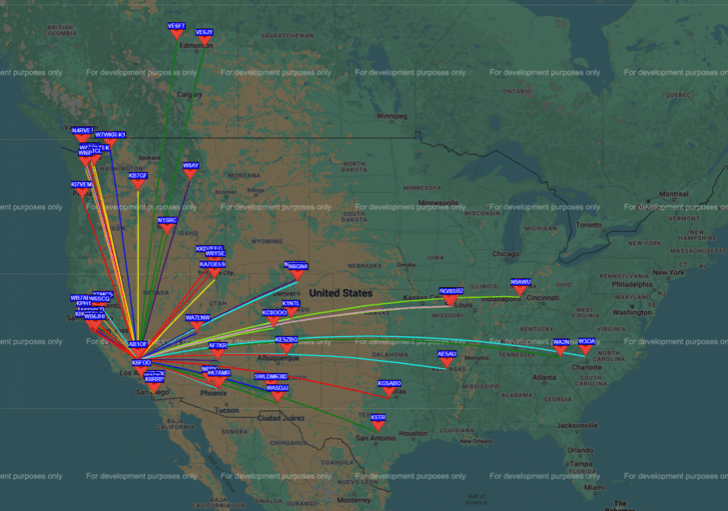
One night of operation on one battery charge yields the following. I’m rather pleased with that for 100mW of power into an inverted V at one-eighth of a wavelength high.
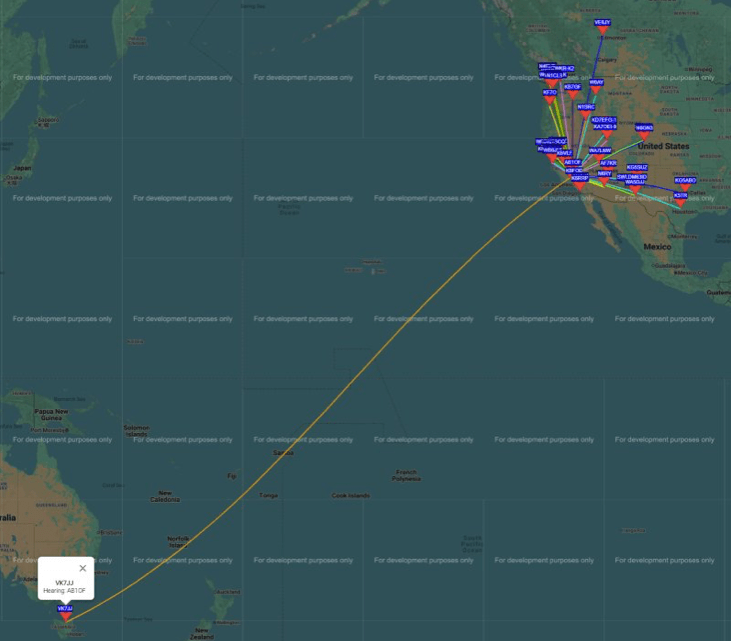
It was even spotted in Tasmania — with 100 mW, on 80m! On a couple of occasions, it got to Alaska, which I thought was pretty good, but Exceter in Tasmania is 12,839km. Almost 130,000 km per watt, with an NVIS antenna made from garbage wire (24 Ga CCA, so aluminum).
If you pick up my WSPR beacon on 20m, the story is somewhat different. This is a more “traditional” approach, using an Si5351A CMOS clock generator programmed around the 20m WSPR frequencies on both sides of 14.097100 MHz.
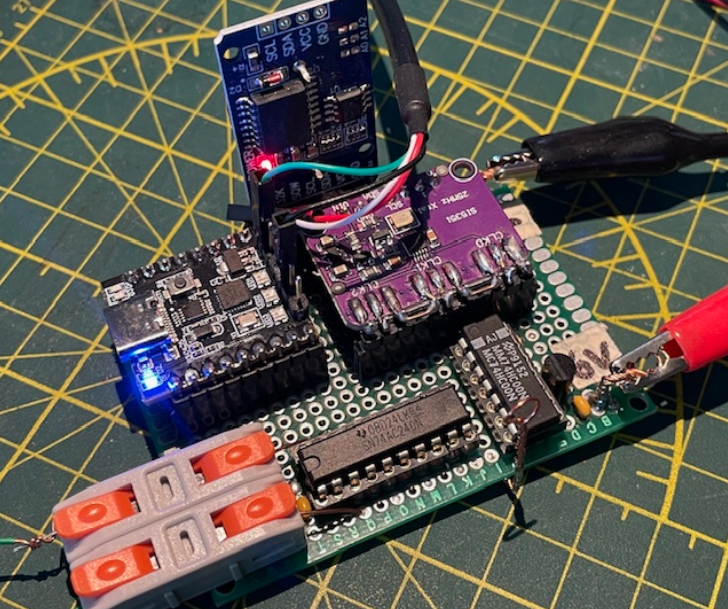
The rest is mostly the same; the LVDS 3.3V p-p signal is boosted to 5V with a 74HC gate, and the PA is a 74AC240, here driven at 6V.
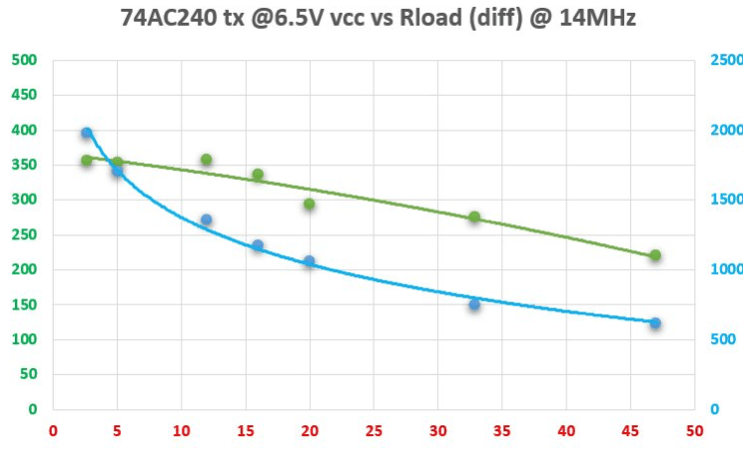
When loaded between 15 and 20 ohms differentially, Pout is around 300mW, and PA dissipation is about a Watt before the output filter. The transmission line (CAT-5) is over 20 ohms resistively alone. The ERP is about 100mW into a resonant inverted V about 7 meters up. 20m is an easy band, so down under and “up over” at VY0ERC showed up within hours.

 ClearSkyRF