To set the stage for future data collection and research opportunities, one of our inaugural projects was a series of Beverage antennas for long-wave, low-frequency bands (receive only).
Why Beverage antennas?
They’re easy and quick to execute. Since they don’t need to be high off the ground, we can mount them on a few 4x4s or telephone poles to gather meaningful data with an MVP setup, instead of spending months on infrastructure.
This post explores how we meet the various criteria for building a Beverage antenna and the specifics of our setup for long-wave, low-frequency bands.
Criteria for building a receive antenna for low-band, weak-signal research
Beverage antennas can receive signals from one or both ends. Weak signal research requires the ability to “aim” where the antennas receive the signal from. Additionally, we need the ability to attenuate/reject undesirable signals to increase the signal-to-noise ratio and, therefore, the ability to decode signals.
A successful Beverage antenna setup for low-band weak signal research goes beyond theories and calculations. Simply finding a site that can accommodate the length of the antenna is quite a challenge. Here are the top considerations and how our 20-acre property enables us to set up four antennas aiming at nine general regions across the globe.
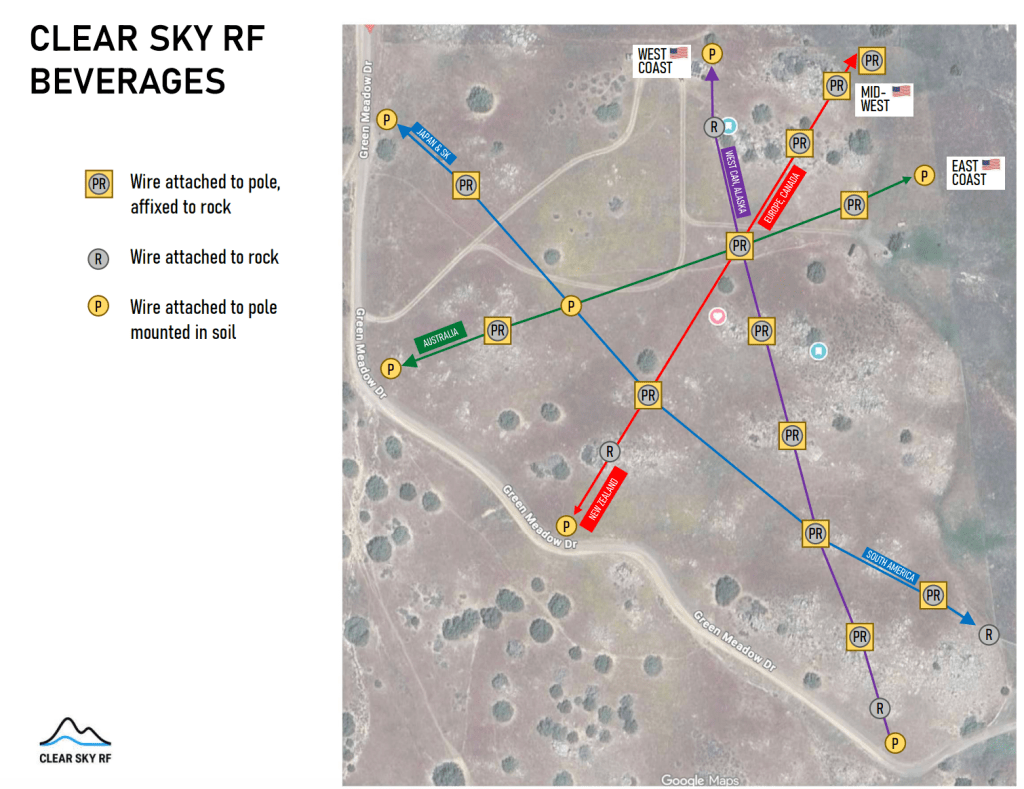
- Technical requirements. Beam pattern design is a tradeoff between desirable technical characteristics (gain, directivity, lobe beam width). The wider the beam, the more you receive, but you also collect more undesirable signals (i.e., noise). While a narrower beam provides more focus, you’d need more antennas to cover all orientations.
- Lobe overlaps. You need a sizable property to achieve the ability to select where the signals come from and orient the antennas so that the lobes overlap just enough to minimize gaps.
- Financial costs. Cables are costly, while low-frequency means a long wavelength. A Beverage antenna must be at least half a wavelength long. The setup shown above requires 3,000’+ of connecting cables.
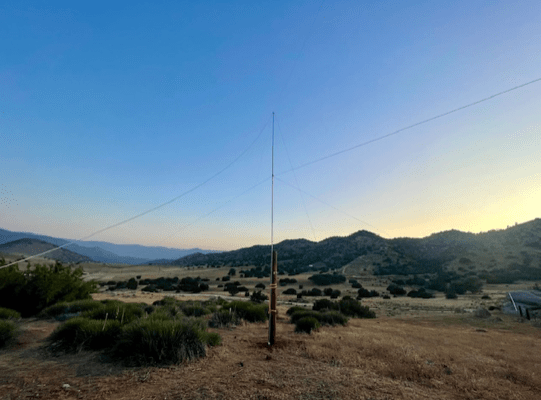
- Physical support for cables. Long cables sag. Our property offers several opportunities where the long antennas intersect at a 45-degree angle, allowing us to set up physical support at a practical cost.
- Real estate. Studying long-wavelength signals means you need acreage to accommodate long antennas. The blue line in the above diagram is 1,500’ long, stretching across the entire property. The site has a fairly “square” shape, allowing us to set up long-wavelength antennas in multiple directions.
- Terrain and mounting opportunities. The property must provide opportunities for mounting antennas so the intersection angles work with the antenna field design. In most cases, researchers must invest time and resources in foundations for anchoring antenna poles or towers. Our property, on the other hand, features rock formations perfect for anchoring antenna poles quickly and cost-effectively.
- Soil characteristics. Beverage antennas work best on rocky/sandy/electrically lossy soil, and our property has just the right type of soil for such research.
The practical implementation of our Beverage antenna series
First, we identify the wavelength to focus our study on.
472 kHz is the sweet spot. The physical dimension still allows for practical implementation on the property. Meanwhile, there are enough people studying it so that we’re not doing this work in a vacuum.
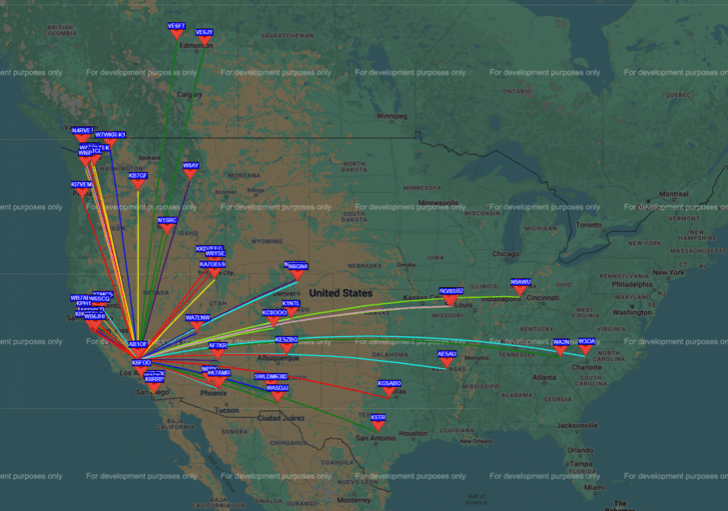
Then, we determine where we pull signals from by segmenting the world and focusing on areas worth isolating, i.e., people are transmitting signals. We started with domestic bearings, segmenting the U.S. into three regions: the West Coast, the Midwest, and the East Coast.
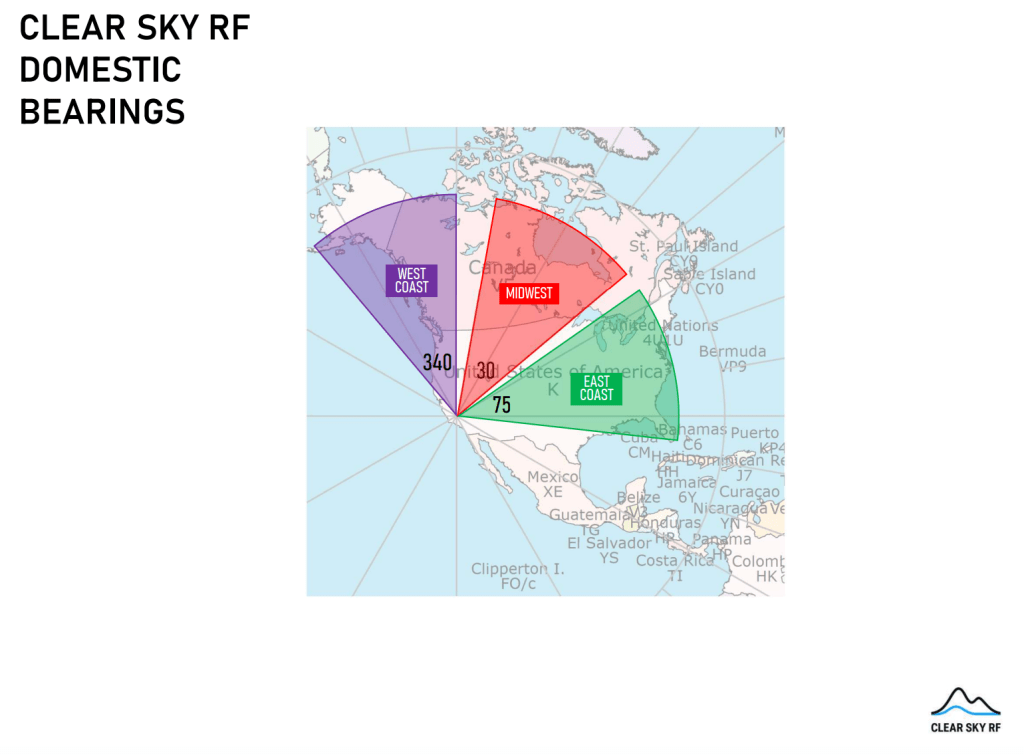
Next, we consider interference sources to inform the antenna’s directionality. Los Angeles is about 100-150 miles south of our site. If we set up an N-S antenna, we’d catch a lot of noise from the city. Instead, we leave a gap between the 340-degree and 30-degree antennas to minimize undesirable signals.
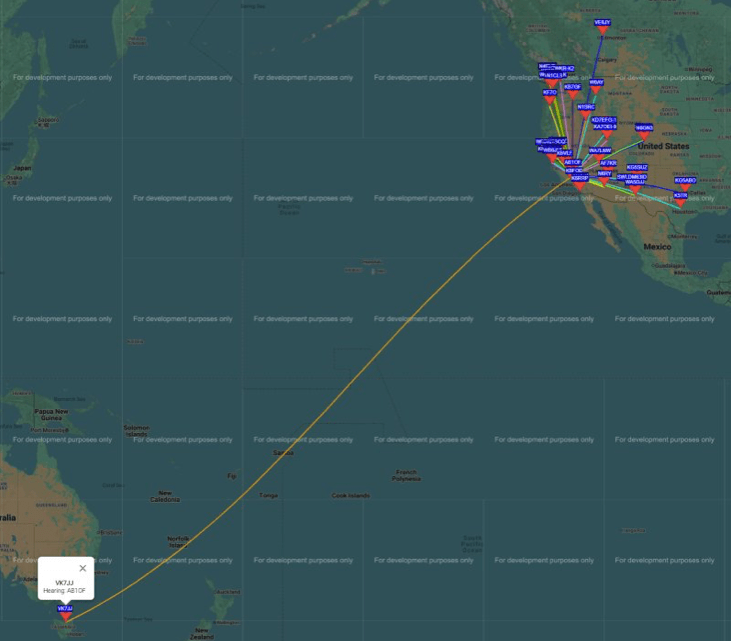
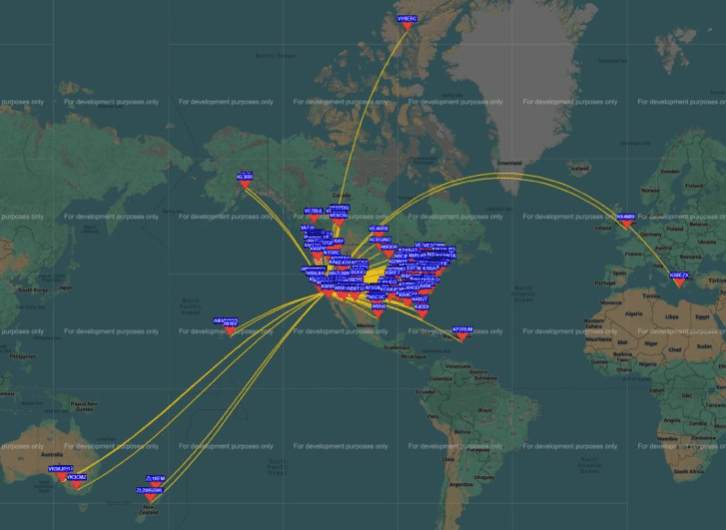
For weak signal research, we want to focus on international targets because domestic ones (while we still want reasonable coverage) are “too easy.” So, we identify regions we can reach on an international map:
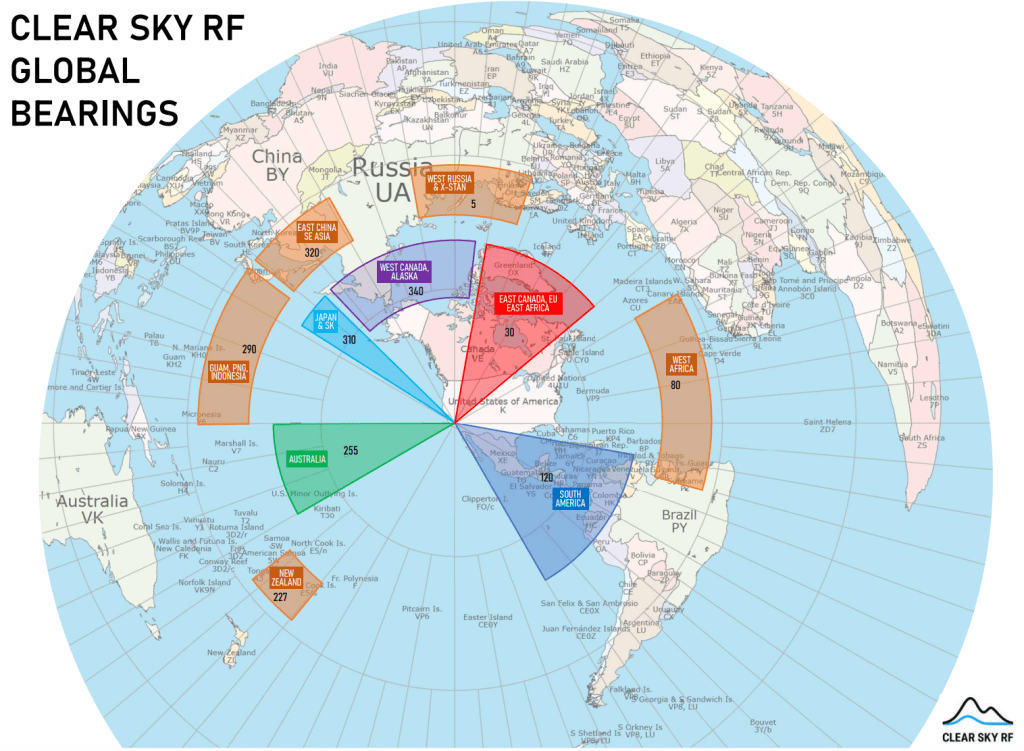
Besides places we can reasonably reach (proven in a few preliminary test runs), we map out “boundary challenges” — stretch targets that don’t have many practical examples of communications on the two lowest bands covering such vast distances.
So, why does this approach make sense?
This setup uses fairly traditional and common communication methods and systems to hone weak signal operations. Once we refine the details and achieve a world-class sensitivity level, we have the groundwork for future research. For example, we can use the data and insights for different applications, such as geological phenomena recording, soil studies, and more.
If you have a research project that can use this Beverage antenna setup, we’d love to hear from you! Get in touch to explore collaboration opportunities.
 ClearSkyRF